Case Study · Classmate
Solving Attendance, Rewards, and Credentialing in One System
Why differentiated NFTs, not a QR code, were the right call for an on-chain attendance dApp in a program that issues no formal certificate.
- Role
- Developer (v1), then Delivery Lead (v2)
- Scope
- On-chain attendance & assessment dApp
- Adoption
- 3+ cohorts, formal assessment workflow
- Outcome
- One verifiable source of truth for attendance and completion
Problem
Web3Bridge had no reliable way to track student attendance across a program, no mechanism to reward students for consistent attendance through a full cohort, and no way to give sponsors verifiable proof of what was actually happening during the program they were funding. Underneath all three was a structural gap: Web3Bridge doesn't issue formal certificates, so there was also no credential a graduate could point to as proof they'd completed the program.
My Role
I was part of the developer team that built v1. I later moved into managing the new development team that shipped v2, and ran onboarding for both students and mentors, including the NFT minting flow itself.
What Happened
We built Classmate as an on-chain attendance and assessment dApp. Rather than a simple check-in system (a QR code, a database entry), we minted differentiated NFTs at each program stage. That decision was deliberate: a QR-style system would prove someone showed up, but it wouldn't prove what they completed or that they graduated, since there was no certificate to point to otherwise. The NFTs did double duty, attendance record and portable, verifiable proof of completion, giving students something ownable that a spreadsheet or internal database never could.
The system runs on three roles. For each class, a mentor mints an attendance NFT and issues a unique claim ID. After the session, students who actually attended receive that ID and use it to claim their NFT, so the on-chain record maps to real presence rather than a sign-in sheet; once the window is over, the mentor closes claiming so the ID can't be reused. Sitting above it, an admin maintains the program itself: creating cohorts and programmes, and managing the mentor and student rosters.
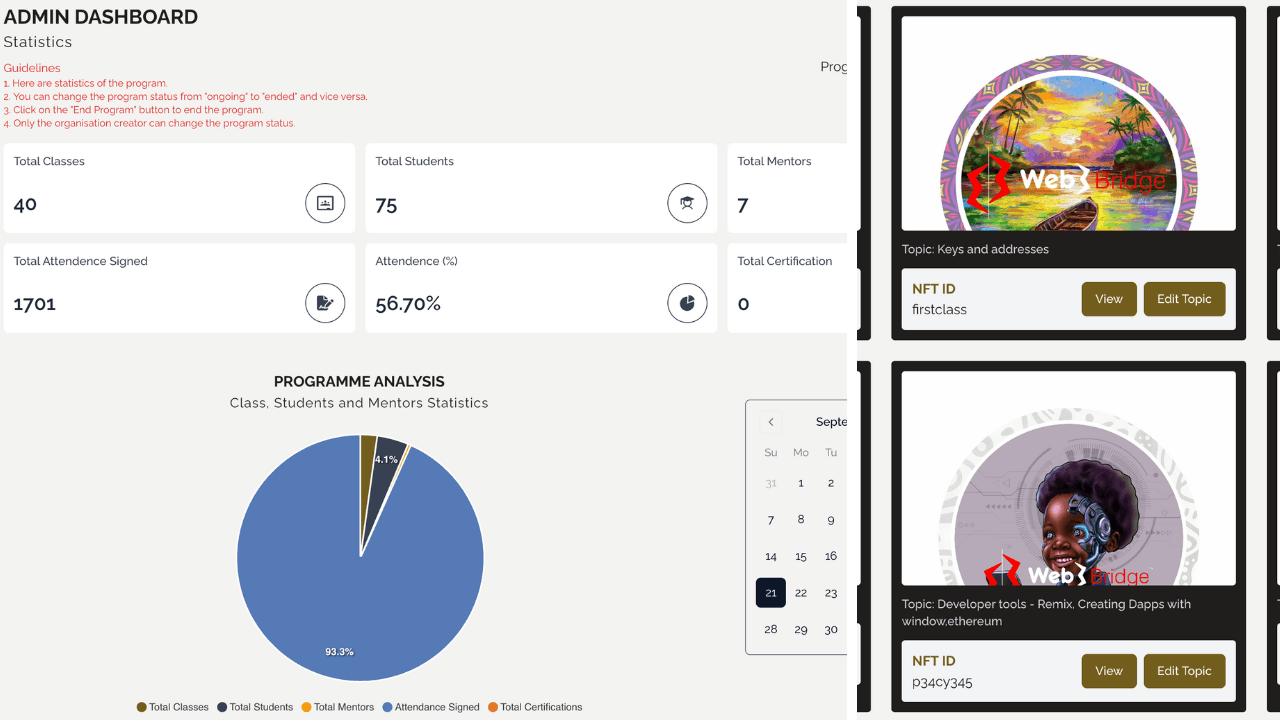
Under the hood it was wallet-native: users signed in by connecting a wallet, and each mint, claim, programme setup, and roster change was its own on-chain transaction. Each programme carried its own generative NFT artwork, mentors could hand a cohort over to one another, admins onboarded students in bulk by file upload, and students tracked their attendance against a class calendar.
1 · The mentor mints
2 · The student claims
3 · The admin maintains
The NFTs did double duty, attendance record and portable, verifiable proof of completion.
Outcome
Classmate v2 is now used across 3+ cohorts as part of the formal assessment workflow, giving students, mentors, and sponsors a single verifiable source of truth in place of spreadsheets.
What I'd Do Differently
The credentialing rationale is the part of this decision I'd defend without hesitation: it solved a real problem a simpler system couldn't. Where I'd want to be more rigorous next time is in documenting that tradeoff analysis as we made it, rather than reconstructing the reasoning from memory a year later. That's on me, not the decision itself.